In the last post, we learned that genes are specific segments of DNA, and that DNA bases that ‘encode’ genes are called ‘coding’ DNA.
Genes (i.e.: a defined combination of bases) contain instructions that tell your cells to make specific proteins. These proteins are responsible for different functions in the body (e.g.: protein antibodies in the immune system, protein clotting factors to prevent bleeding, etc.)
As your entire genome is present in every cell of the human body, your genes are also inside every cell in the body. Different cells will turn on, or ‘express’, different genes depending on their function in the body. For example, an eye cell may express the gene responsible for eye pigment/ color, whilst a liver cell may express the gene responsible for metabolizing alcohol.
When genes are ‘expressed’, the body uses the gene and its encoded instructions to make the corresponding protein through processes called ‘transcription‘ and ‘translation‘. So when a liver gene expresses the gene responsible for metabolizing alcohol, it means that the protein responsible for metabolizing alcohol is produced in the body.
Gene regulation* is responsible for determining which cells will express which genes, and is a complex process that we do not yet fully understand.
So essentially, DNA contains genes, and genes contain the instructions to make proteins.
But how exactly are proteins made?
Here’s where the processes of transcription and translation come in.
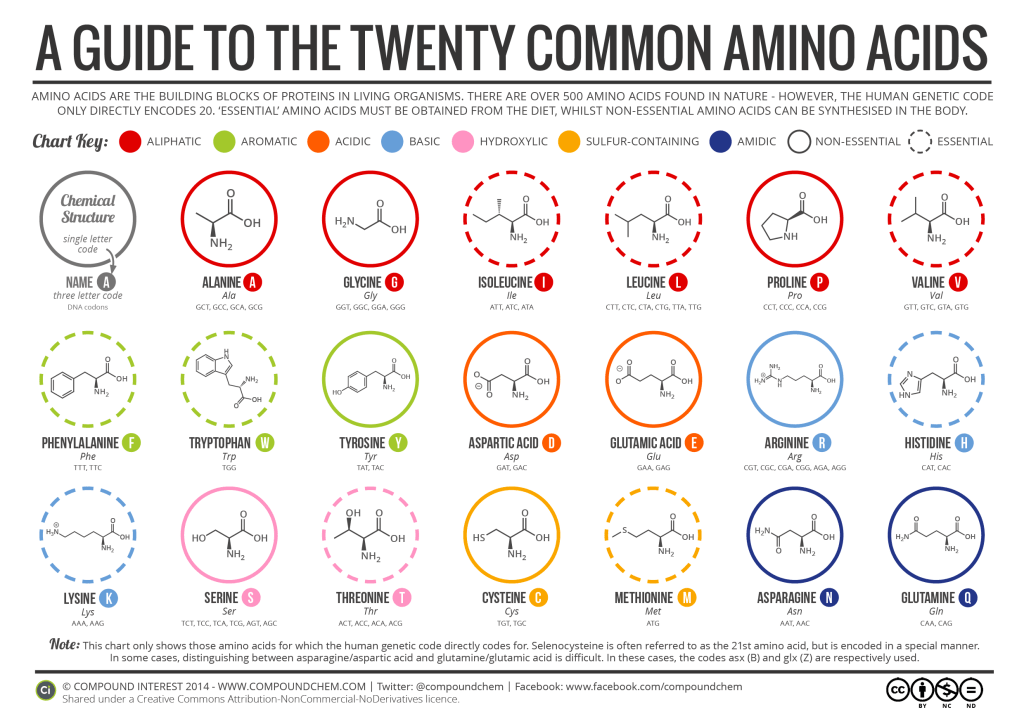
Proteins are large complex molecules that play critical roles in the body (as mentioned above), and are structurally made up of a chain of amino acids. There are 20 amino acids in the human body. Every 3 nucleotide bases in a gene (called ‘codons‘) correspond to a specific amino acid (e.g.: the GCT codon codes for Alanine, the TAT codon codes for Tyrosine, etc.).
You can see the codons for each amino acid in the image below:
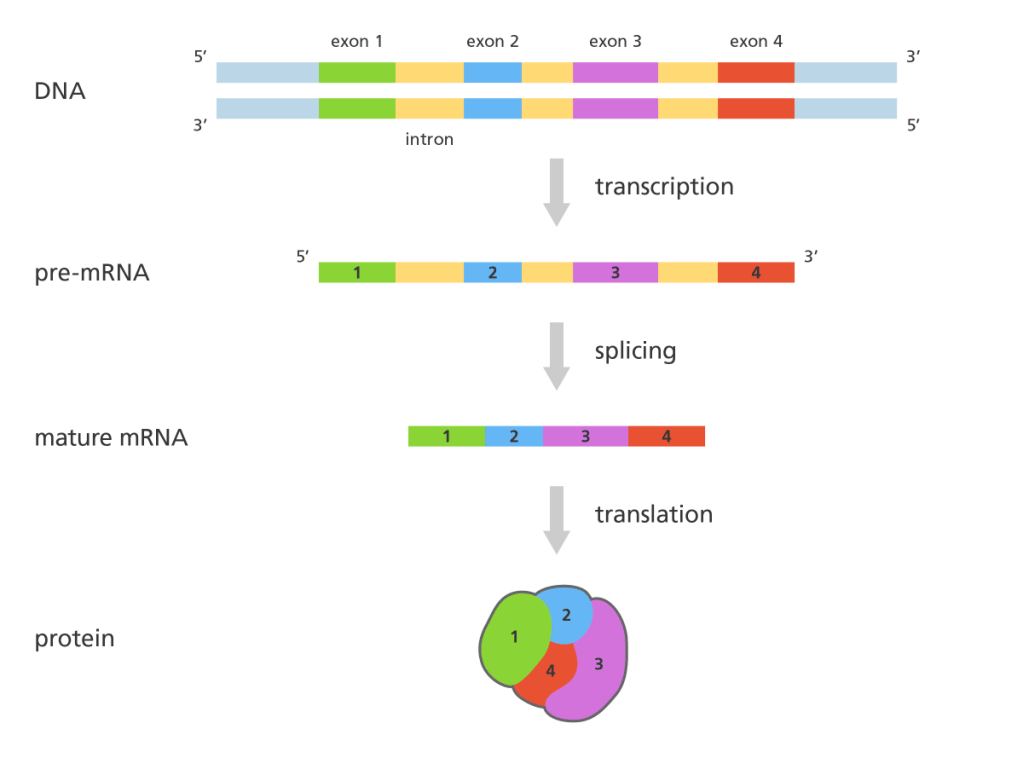
To describe the processes in a simple way: remember that DNA is double-stranded. In transcription, a single strand of the gene (i.e.: defined DNA segment) is copied by a protein called RNA polymerase. This copied strand is called Messenger RNA, or ‘mRNA’, and contains the instructions/ ingredients for a protein. Before translation, mRNA goes through a process called ‘splicing‘* where unnecessary or ‘non-coding’ codons (‘introns‘)**, are removed.
In translation, the remaining ”coding’ codons (‘exons’) in the mRNA strand are ‘read’ and translated to the corresponding amino acids, to form a chain of amino acids, called a ‘polypeptide chain’. This chain then folds on itself into a 3D structure, and voilà, it’s a protein!
Here’s a summary of the whole process:
And here’s a simple video that explains the above***:
It’s goes into a little more detail than I do above, but should act as a useful visual.
And that’s all for today!
*We’ll explore the processes of gene regulation and splicing in separate posts.
**Over 98% of the human genome is non-coding DNA (‘introns‘). We used to think of this type of DNA as junk, but really we are discovering that they play a crucial role in regulating genes, and in epigenetics (the interaction between genes and the environment).
***When I have a larger audience and more funding – perhaps I can make my own videos 🥳


Leave a comment